
Inversor solar para hogares fuera de la red: Guía completa de compra 2026, tamaño y diseño del sistema
Por hqt
2026.06.18Publicaciones relacionadas
SANDISOLAR se asocia con Jinko Solar para llevar a cabo un proyecto solar y de almacenamiento fuera de la red de 10,7MW
23 de septiembre de 2026
Inversor fuera de red de 48V 6kW: Por qué los sistemas de baterías de 48V son comunes en sistemas solares de mayor potencia
31 de agosto de 2026
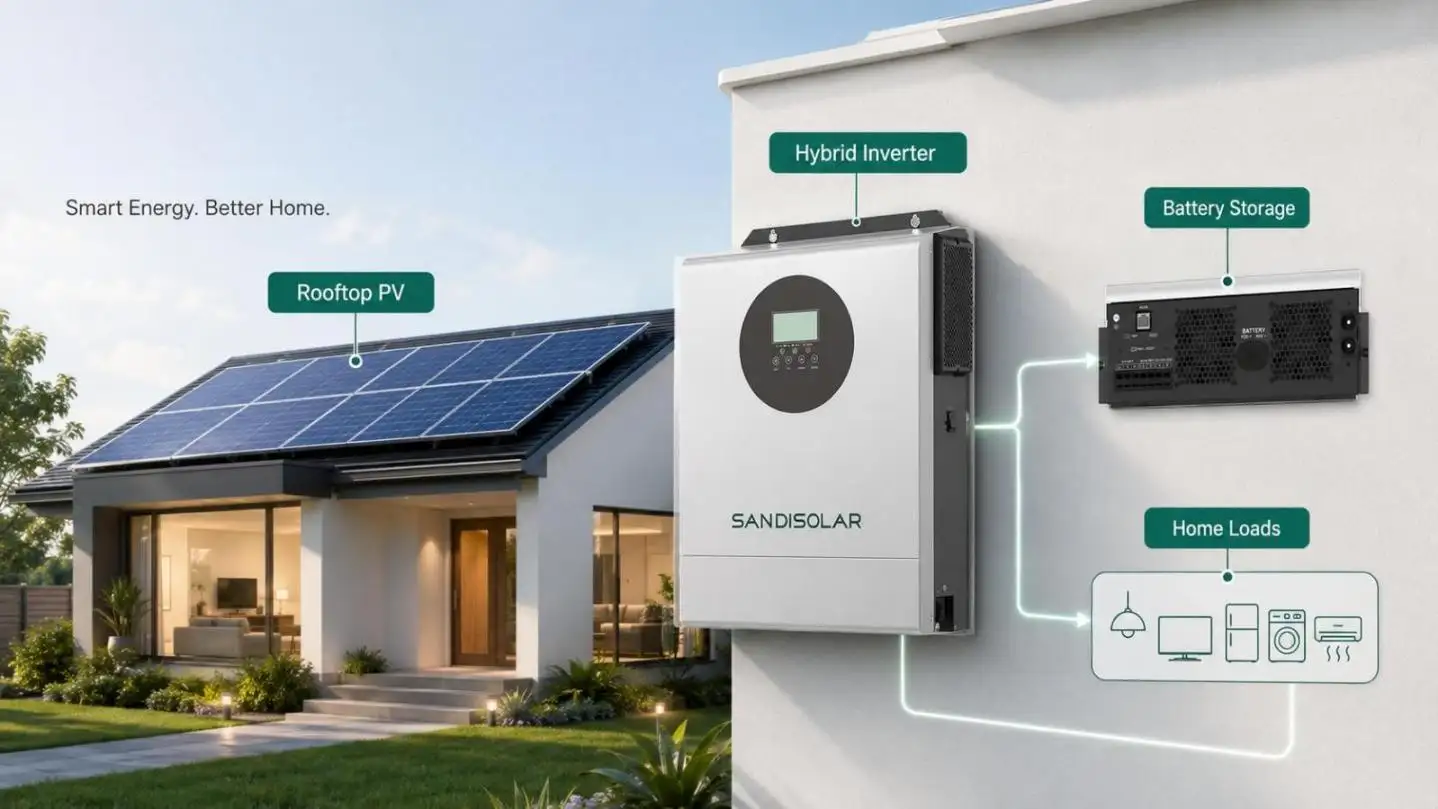
Instalación de sistemas solares residenciales: Dimensionamiento técnico, ajuste de sistemas y guía de instalación
31 de agosto de 2026
Inversor solar para hogares fuera de la red: Guía 2025 para dimensiones, selección y diseño de sistemas
Un sistema solar fuera de la red depende de un componente crítico: el inversor solar. Convierte la energía de corriente continua de tus cuadros y baterías en corriente alterna para tus electrodomésticos y funciona de forma independiente de cualquier red eléctrica.
Esta guía cubre cómo funcionan los inversores fuera de la red, qué observar, las tendencias actuales del mercado, métodos de dimensionamiento, costes típicos y consejos prácticos de diseño. Está escrito para compradores que buscan una solución técnicamente sólida y no solo una lista de productos.
1. ¿Qué es un inversor solar para hogares fuera de la red?
Un inversor solar para hogares fuera de la red convierte la electricidad de corriente continua de paneles solares y almacenamiento de baterías en electricidad de corriente alterna para uso doméstico. A diferencia de los inversores conectados a la red, un inversor fuera de la red debe:
- Proporciona su propia referencia de voltaje y frecuencia (actuando como la "red" de tu hogar)
- Manejar cargas de sobretensión a corto plazo de motores y compresores
- Funcionan continuamente con la batería y la energía solar, a menudo en entornos hostiles
Si necesitas una verdadera independencia energética —ya sea para una casa de campo, cabaña, resort en isla o estación de telecomunicaciones— elegir el inversor fuera de la red adecuado es importante.
2. Por qué los inversores solares fuera de la red importan más en 2025
2.1 Creciente demanda de independencia energética
Los costes energéticos son volátiles y los cortes de red son más frecuentes en muchas regiones. Las zonas remotas de África, el sudeste asiático y América Latina dependen de la energía solar fuera de la red como su principal fuente de energía. Incluso en países desarrollados, más propietarios quieren sistemas de respaldo autónomos que puedan funcionar durante días sin energía de la red.
2.2 Caída de los precios de las baterías y mayor integración
Los precios de las baterías de iones de litio y LFP han caído significativamente. Esto permite bancos de baterías más grandes, que requieren inversores con control avanzado de carga y comunicación del sistema de gestión de baterías.
2.3 Inversores más inteligentes y eficientes
Los modelos recientes ofrecen una eficiencia de conversión superior al 96%, controladores de carga solar MPPT integrados, monitorización basada en aplicaciones, conectividad Wi-Fi y salidas de carga programables con arranque automático del generador.
2.4 Política y Finanzas
Muchos gobiernos apoyan la energía solar y el almacenamiento mediante subvenciones o créditos fiscales. Actualmente, los bancos financian la energía solar fuera de la red en mercados emergentes, lo que eleva los estándares de calidad en toda la industria.
3. Tipos de inversores solares para hogares fuera de la red
3.1 Inversor puro fuera de red (cargador inversor)
Un inversor/cargador clásico fuera de la red extrae energía de corriente continua del banco de baterías, la convierte en corriente alterna para cargas domésticas e incluye un cargador de baterías para generadores de respaldo o entrada de red. Normalmente necesitas un controlador de carga solar MPPT separado para conectar los paneles fotovoltaicos.
Ventajas: Robusto para zonas remotas, flexible con diferentes tipos de baterías y tamaños de generadores, fácil de mantener completamente aislado.
Contras: Requiere componentes adicionales, cableado más complejo, ocupa más espacio.
3.2 Inversor híbrido (Red de baterías solares/generador)
Un inversor híbrido combina funcionalidad conectada a la red, operación fuera de la red o de respaldo, carga de baterías desde solar/red/generador y controladores MPPT integrados. Muchas casas consideran que esta es la mejor opción: ahora funciona fuera de la red y puede conectarse a una red más tarde si es necesario.
Ventajas: Solución todo en uno, instalación más sencilla, buena para zonas con redes poco fiables.
Contras: Un firmware más complejo, la compatibilidad con ciertas baterías requiere modelos específicos, no todos están totalmente optimizados para funcionar 100% fuera de la red.
3.3 Unidad de Energía Todo en Uno fuera de la red
Estos integran el inversor fuera de la red, el controlador solar MPPT, el cargador de baterías, los interruptores de corriente continua y, a veces, una pantalla de monitorización. Es común en sistemas residenciales y comerciales pequeños de 1-10 kW.
Ventajas: Compacto, con menor coste de instalación y interfaces fáciles de usar.
Contras: Menos modular, reemplazar una función puede requerir reemplazar toda la unidad, la gestión del calor es crítica.
4. Características clave a buscar en un inversor solar doméstico fuera de la red
4.1 Potencia continua y capacidad de sobretensión
La potencia continua (kW) es la potencia máxima que el inversor puede suministrar de forma continua. Elige una valoración por encima de tu pico de demanda. Muchas cargas—bombas, frigoríficos, aires acondicionados—consumen 2-3 veces su potencia de funcionamiento al arrancar. Los inversores fuera de la red deben soportar esta sobretensión durante unos segundos.
Para una cabina pequeña, funciona un inversor de 3-5 kW. Una casa familiar mediana necesita entre 5 y 8 kW. Las casas grandes con alta demanda o con aire acondicionado pesado necesitan entre 8 y 15 kW o varios inversores en paralelo.
4.2 Calidad de la forma de onda (Onda Senoidal Pura)
Siempre elige un inversor de onda senoidal pura. Los inversores de onda sinusoidal modificados son más baratos pero la electrónica sensible al sobrecalentamiento, provocan zumbidos en los equipos de audio y reducen la eficiencia del aparato.
4.3 Compatibilidad de baterías y carga
Los sistemas fuera de la red se centran en el almacenamiento. Busca soporte para baterías de litio (LiFePO4) y plomo-ácido (AGM, GEL), voltajes de carga ajustables, comunicación CAN/RS485 con sistemas de gestión de baterías y límites programables de estado de carga. Si planeas actualizar de plomo-ácido a litio más adelante, asegúrate de que el firmware del inversor soporte ambos.
4.4 Integración con el controlador de carga solar MPPT
Muchos inversores modernos incluyen entradas MPPT. Comprueba el voltaje máximo de entrada PV, la corriente, la potencia de la matriz por canal y el número de canales MPPT. Es común sobredimensionar las matrices PV algo por encima de la nominal nominal del inversor.
4.5 Eficiencia y consumo en espera
La eficiencia de conversión impacta directamente en la cantidad de energía almacenada que puedes usar. Busca una eficiencia superior al 95%. En sistemas fuera de la red, el bajo consumo en espera es importante porque significa más energía para tus cargas.
4.6 Salida de CA: Voltaje, frecuencia y fases
Ajusta el inversor al estándar eléctrico local: monofásico para hogares pequeños y medianos, trifásico para ciertas bombas y motores. Utiliza el voltaje nominal de tu región (120/240 V en Norteamérica, 230 V en muchas otras) y la frecuencia correcta (50 Hz o 60 Hz). Algunos inversores fuera de la red pueden conectarse en paralelo para aumentar la potencia.
4.7 Protección y seguridad
Las protecciones críticas incluyen protección contra sobrecarga y cortocircuitos, protección contra sobre/bajo voltaje, protección contra sobrecalentamiento con reducción de taxis, detección de fallos a tierra y protección contra islas. Verifica el cumplimiento de las normas relevantes en tu región.
4.8 Monitorización y Control Inteligentes
Un inversor de calidad de 2025 debería tener una pantalla local para parámetros clave, conectividad Wi-Fi o 4G, una aplicación móvil y registro de datos para análisis de rendimiento. La monitorización inteligente facilita mucho optimizar el rendimiento y detectar problemas a tiempo.
4.9 Calificación medioambiental y calidad de construcción
Para climas duros, comprueba la clasificación IP para proteger el polvo y el agua, el rango de temperatura de funcionamiento, el método de refrigeración y la robustez mecánica.
5. Cómo dimensionar un inversor solar para una vivienda fuera de la red
5.1 Paso 1: Lista y clasifica tus cargas
Identifica todas las cargas: cargas continuas (iluminación, routers), cargas intermitentes (frigorífico, bomba de agua) y cargas críticas (equipos médicos, sistemas de seguridad). Registrar la potencia nominal, las horas diarias de funcionamiento y si tienen un alto pico de arranque.
5.2 Paso 2: Calcular la demanda máxima
Estima el consumo máximo simultáneo de energía. Esto no es la suma de todas las cargas, sino la suma de cargas que operan juntas de forma realista.
Ejemplo para una casa de tamaño medio:
- Frigorífico: 150 W (600 W de sobretención)
- Luces: 150 W
- TV, router, electrónica: 200 W
- Lavadora: 600 W
- Bomba de agua: 750 W (2 kW de tensión)
- Aire acondicionado pequeño o ventilador: 800 W
Extracción simultánea realista: 2.650 W continuo. Pero el aumento de presión podría superar los 4-5 kW. Selecciona al menos un inversor de onda senoidal pura de 5 kW con buena capacidad de sobretensiones.
5.3 Paso 3: Incluir la expansión futura
Si planeas añadir electrodomésticos más adelante, ten en cuenta entre un 20 y un 50% de capacidad extra y la opción de inversores en paralelo.
5.4 Paso 4: Comparar la energía fotovoltaica y la batería con el tamaño del inversor
El tamaño del inversor debe alinearse con el voltaje del banco de baterías (24 V, 48 V o superior), la capacidad planificada de la batería y el tamaño de la matriz fotovoltaica. En 2025, 48 V CC es común en inversores residenciales fuera de la red entre 3 y 10 kW.
6. Costes típicos y consideraciones sobre el retorno del investimento (2024-2025)
6.1 Rangos de precios de inversores
Pequeña casa o cabina fuera de la red (1-3 kW): todo en uno o cargador con inversor suele costar entre unos cientos y pocos miles de dólares equivalentes.
Vivienda de tamaño medio fuera de la red (5-8 kW): inversores de onda senoidal pura o híbridos de calidad suelen oscilar entre los pocos y mediados mil USD.
Sistema grande fuera de la red (10-20 kW): inversores múltiples en unidades paralelas o de grado comercial cuestan significativamente más dependiendo de la complejidad.
Considera siempre el coste total de propiedad: pérdidas de eficiencia en 10-15 años, riesgo de reemplazo y costes de inactividad en zonas remotas.
6.2 Retorno y valor
Los sistemas fuera de la red son cada vez más competitivos en comparación con los generadores diésel (altos costes de combustible y mantenimiento) y la extensión de la red en regiones remotas (prohibitivamente caras o retrasadas). El coste del inversor suele ser una porción modesta del coste total del sistema, pero su fiabilidad influye fuertemente en el valor de por vida.
7. Diseñar un sistema solar robusto fuera de red alrededor del inversor
7.1 Arquitectura básica fuera de red
Una casa solar típica fuera de la red incluye paneles solares fotovoltaicos que alimentan las entradas MPPT del inversor, un banco de baterías conectado al bus de corriente continua, salida de corriente alterna al tablero de distribución del hogar y entrada opcional para el generador de carga de respaldo.
7.2 Diseño del banco de baterías
Las decisiones clave incluyen la química (litio vs. plomo-ácido), la capacidad de almacenamiento basada en el consumo diario y los días deseados de autonomía, y los objetivos de profundidad de descarga. El inversor debe soportar el voltaje y el estilo de gestión de la batería que elijas.
7.3 Integración de generadores
Utiliza el inversor-cargador para arrancar automáticamente el generador cuando el SOC de la batería está bajo o las cargas son altas. Asegúrate de que la salida del generador esté dentro de las especificaciones de voltaje y frecuencia de entrada de corriente alterna del inversor. Ten en cuenta el ruido, la logística del combustible y los intervalos de mantenimiento.
7.4 Gestión de carga y eficiencia
Los mejores inversores fuera de red pueden priorizar cargas críticas, eliminar cargas no esenciales cuando la batería está baja y programar cargas pesadas durante las horas soleadas. Los propietarios pueden reducir el estrés del inversor utilizando electrodomésticos eficientes energéticamente y evitando el uso simultáneo de varios dispositivos de alta potencia.
8. Errores comunes al elegir un inversor solar para hogares fuera de la red
- Subdimensionar el inversor para cargas pico y de picos
- Ignorando la compatibilidad de baterías, especialmente en sistemas de litio
- Elegir inversores de onda sinusoidal modificados para ahorrar dinero desde el principio
- Ignorando la temperatura ambiente y las necesidades de ventilación
- Usar inversores que no estén certificados ni soportados en tu región
- No planificar futuras expansiones
- Descuidar la monitorización y el soporte postventa en ubicaciones remotas
9. ¿Quién debería considerar un inversor solar fuera de la red?
Un inversor solar fuera de la red correctamente especificado es ideal para hogares y granjas remotas sin acceso a la red, ecocabañas y resorts que buscan energía tranquila, telecomunicaciones e infraestructuras críticas en zonas rurales, viviendas en regiones con red débil que necesitan respaldo independiente, y promotores que construyen comunidades alimentadas por energía solar.
10. Lista de verificación práctica para seleccionar un inversor solar para uso doméstico fuera de la red
- Aplicación: ¿Totalmente fuera de red o híbrido con red/generador opcional?
- Potencia de potencia: ¿La potencia continua y la de sobretensión cubren tus cargas máximas reales?
- Forma de onda: Solo onda senoidal pura.
- Batería: voltaje, química soportada, opciones de comunicación BMS
- Integración solar: límites de voltaje/corriente MPPT, número de entradas, tamaño máximo de la matriz fotovoltaica
- Eficiencia: Eficiencia de conversión y consumo en espera
- Especificaciones de CA: Voltaje, frecuencia, monofásico/trifásico, capacidad en paralelo
- Protecciones: Sobrecarga, cortocircuito, sobretemperatura, protección contra sobretensiones
- Funciones inteligentes: aplicación de monitorización, registro de datos, configuración remota
- Medio ambiente: clasificación IP y rango de temperatura para tu clima
- Certificación y garantía: Cumplimiento de las normas pertinentes y garantía sólida
- Servicio y soporte: Disponibilidad de asistencia técnica, repuestos, socios locales
11. Conclusión y próximos pasos
Elegir el inversor solar adecuado para hogares fuera de la red en 2025 requiere equilibrar el rendimiento técnico, la fiabilidad y el valor a largo plazo. El inversor que elijas definirá qué tan bien tus paneles solares y baterías apoyan tu estilo de vida, ya sea que uses una cabaña compacta o una casa familiar de tamaño completo.
Céntrate en cálculos precisos de carga y picadas, compatibilidad con baterías y fotovoltaicos, protecciones robustas y monitorización inteligente, y un diseño que permita futuras expansiones.
Para muchos propietarios y promotores de proyectos, trabajar con un proveedor especializado o un socio de ingeniería es la vía más eficiente hacia una solución fiable y rentable. Un diseño adecuado del sistema desde el principio evitará actualizaciones repetidas y soluciones de problemas más adelante, y garantizará que tu inversor fuera de la red proporcione energía estable y limpia durante años.


Contáctenos
En este artículo
Publicaciones relacionadas
SANDISOLAR se asocia con Jinko Solar para llevar a cabo un proyecto solar y de almacenamiento fuera de la red de 10,7MW
23 de septiembre de 2026
Inversor fuera de red de 48V 6kW: Por qué los sistemas de baterías de 48V son comunes en sistemas solares de mayor potencia
31 de agosto de 2026
Instalación de sistemas solares residenciales: Dimensionamiento técnico, ajuste de sistemas y guía de instalación
31 de agosto de 2026